Noah's Residents

Noah's Residents
Showing posts with label Street Cats. Show all posts

Wednesday, April 1, 2015

A lonely journey of compassion

This article was written with permission from Mr T.T. Lim

Noah’s Ark Natural Animal Sanctuary (NANAS) has seen its fair share of animal hoarders and the condition of the animals who had become the prisoners of their love. Most of them start off with good intentions and have compassion for the animals. When they see a stray, they find it impossible to turn away. They allow their hearts to rule their heads and became addicted to the accumulation of more animals. They are overwhelmed by their well-meaning intention that their animal care is neglected or compromised.  

Take the case of Mr T.T. Lim.  His neighbors label him as the “Crazy Cat Man”.  Uncle Lim is 67 years old, a retired bachelor who lives with his street cats.  The cats are like his children and he knows each by name and their medical histories. He retreated from socializing with his friends because of his cats. His friends stopped dropping by his house because of the stench of the cats’ faeces and urine and possible health risk to themselves. Neighbours complained about the presence of cats’ waste in their gardens and infestation of parasites. Eventually, he became withdrawn and isolated.

This kind man would bring his rescues to our Noahs’ Ark Animal Birth Control (ABC) Clinic in Melaka for medical treatment and sterilization.  Uncle Raymund has shared and counseled Uncle Lim on the following:-

(a)  Management of community cats i.e. that instead of the scattered, random  approach adopted by Uncle Lim on picking up stray cats across a wide geographical area, he should concentrate on specific locations, for example, the food-court at Bukit Bruang.  This way he could get an idea of the cat population there and to sterilize as many as possible. This approach is faster and has more visible impact to curb the over-population. Furthermore he would be able to contain and manage any infection afflicting them.

(b)  Quarantine of sick animals and proper nursing protocol. Invariably the cats Uncle Lim rescued are afflicted with respiratory infection.  In order not to transmit any infection to his healthy cats, Uncle Lim should not allow them to have any contact.

(c)  Trap Neuter and Release (TNR). Cats that have been neutered must be returned to where they were first caught.  However after having nursed the sick animal to health or after sterilization, Uncle Lim forms a strong attachment to the animal and cannot bear to release them. The “R” in the TNR did not materialize. Thus, began the accumulation of cats in Uncle Lim’s household.

Sometime in May 2014, while Uncle Lim was mopping the kitchen floor in his home, he slipped and landed on his back. His injuries were so severe that he laid paralyzed and helpless for three days.  Without food and water, Uncle Lim drifted in and out of consciousness.  His shouts for help were unanswered as he lived alone.  

On the third day after the fall, a friend dropped by his house, after failing to get him on the phone. Uncle Lim knew this was his last chance to get attention from his friend, otherwise he knew that he would not make it.  He mustered all his strength and expelled an explosive shout. His friend quickly attended to him and called the ambulance.  

No one knew the exact number of cats in this multi-cat household except that the population was burgeoning.  The 30 odd cats that hung around the house were stressed, frightened and ill.  A Noah’s Ark volunteer, Shaqira did most of the heavy work – feeding and nursing the cats on daily basis. She took it upon herself to clean and mop the house because the cats, in their stressed condition, had defecated on the floor and other surfaces. 

I wished that Uncle Lim had listed the total number of cats and their respective medications, rather than us doing “a guessing game”. Due to the overcrowding and the deteriorating housing condition, more cats were falling sick. Some started to linger outside the house, becoming a nuisance to the neighbours.  Whilst we took turns to shuttle to Uncle Lim’s house daily to tend to his furry friends, we felt the strain as we had to juggle our own personal responsibilities with the added workload.

At best, we managed to find homes for some of the kittens. Sadly, there were no takers for the rest of the cats.  It is unconscionable to abandon the cats and let them fend for themselves as the street is not their home.  I kept Uncle Raymund updated of Uncle Lim’s medical condition which would require long recuperation,  the deteriorating sanitary conditions of Lim’s house and the complains from his neighbours of the nuisance  from the cats. Uncle Raymund offered the sanctuary as a permanent home for the cats on compassionate grounds.

We set out with our rescue mission to bring the cats safely to the sanctuary. However, we were met with obstacles. Cats are highly territorial creatures and those 30 felines were very suspicious and mistrustful of us.  Some tried to hide almost immediately when we entered the premises.  It was a daunting task to coax the cats into our carriers and now I understand why “herding cats” is a synonym for “chaos”.

After an exhausting “cat and mouse” chase as some of the cats were stubbornly elusive, we manage to round up all the cats without any “cat-astrophe.” The cats’ first stop was the ABC Clinic in Melaka as a temporary holding area where they were de-fleaed and de-wormed until they were re-located to the sanctuary.  We also provided food and water.

Cats getting ready for their journey from
Melaka to Noah's Ark in JB.


A mother cat nursing her kittens.
On 31 May 2014, Raymund and I visited Uncle Lim at the hospital to provide updates on his 30 furry friends and assured him that Noah's Ark will become the cats’ forever home. His eyes teared.  The grief, guilt and burden that Uncle Lim had been shouldering were lifted. I could tell that Uncle Lim is grateful to Noah's Ark. He can now focus on recovery. 

On the same evening, it took six people to hoist the carriers and secure them properly for the cats’ two hour journey to their “Purr-adise”.  45 minutes later, our rescue mission was completed.  

On 7 March 2015 ,Uncle Lim celebrated
his birthday.  He is now residing
at a nursing home.
Uncle Lim has also undergone surgery and has cervical spine disc prosthesis implanted in situ c3/c4, c4/c5 and c5/c6.  Recovery will take a longer due to his age.  Most importantly, he has a positive outlook in life and he hopes that one day he is able to continue caring for the community animals.

Instead of being appreciated for his compassion for the street cats, Uncle Lim was judged negatively, either as a hoarder, eccentric feeder or a person with mental disorder. He was ostracized.  It tells us something about our society’s treatment towards stray animals and their carers. We hope that our society is able to reach out to help those in need and support them with help such as veterinary care or placement of these animals.

By Siah Li Mei


Note:
Please do read our articles on Where there’s a pet, there is a will and The importance of including your pet in your will and a video on “The street is not their home.”


Meet Uncle Lim's cat residents at Noah's Ark.


Tuesday, March 10, 2015

Kai Kai a lucky cat's journey


It took a lady 2 days of coaxing and patience to get this young cat out of the drain. 
The rescued cat was brought into Noah's Ark clinic for treatment. When it arrived, he was given a through physical examination and it had urine sores around his pelvic areas. His bladder was very distended and promptly an indwelling urinary catheter was insert to help him to urinate. We waited for the miserable kitty's condition to be stabilised.


Dr Kesia from Mount Pleasant clinic volunteered to travel to Noah's Ark to perform a cystotomy to remove the struvites* and bloody plugs.  Dr Kesia's compassion and caring ways brought comfort to this young cat and myself. 


Now I have a to bring him along with me to Muar and Malacca Animal-Birth-Control clinic tour because he requires intensive care for the next 3 days. I shall name him "Little Kai Kai".
By Raymund Wee

Footnote*
Urinary Tract Stones (Struvite) in Cats
Urolithiasis is a medical term referring to the presence of stones in the urinary tract. Struvite is a material that is comprised of magnesium, ammonium and phosphate.

Urolithiasis is a medical term referring to the presence of stones in the urinary tract. Struvite is a material that is comprised of magnesium, ammonium and phosphate. These type of stones can be found in the urinary bladder, the urethra or in the kidneys. While some forms of the stones can be flushed out or dissolved, others must be removed surgically.

Symptoms and Types
Many animals do not display any signs or symptoms of the disease. However, some will have:

·         Abnormal urine patterns
·         Difficulty urinating (dysuria)
·         Frequent urination
·         Bloody urine (hematuria)
·         Cloudy urine
·         Increased thirst
·         Enlarged belly 

The most common urinary tract stones (uroliths) are struvite and oxalate. Struvite stones are crystal-like formations that are small in size and primarily made up of magnesium, ammonium and phosphate. When cats have struvite plugs in their urethra (the tube that extends from the bladder to the outside of the body to discharge urine), they are typically comprised of larger stones and are often mixed with crystals.

Causes
The median age for urolithiasis is around seven years old and it is more common in female animals than in males. Animals that have small urethral outlets are also more prone to develop these type of obstructions. It is thought that the stones are developed following urinary tract infections, as well as when large quantities of minerals are bound to other foreign materials such as tissue, blood and other inflammatory reactants.
  
Diagnosis
Sometimes a thicker bladder wall will be felt by the veterinarian; difficulty urinating and an abnormal outflow may also be diagnosed. Urine samples will be obtained by the veterinarian to examine for abnormalities. Ultrasounds are used to determine the size, shape and location of the stones for treatment options; other imaging tests may also be performed to determine if there are any other underlying medical conditions.

Source: http://www.petmd.com/cat/conditions/urinary/c_ct_urolithiasis_struvite


Tuesday, January 6, 2015

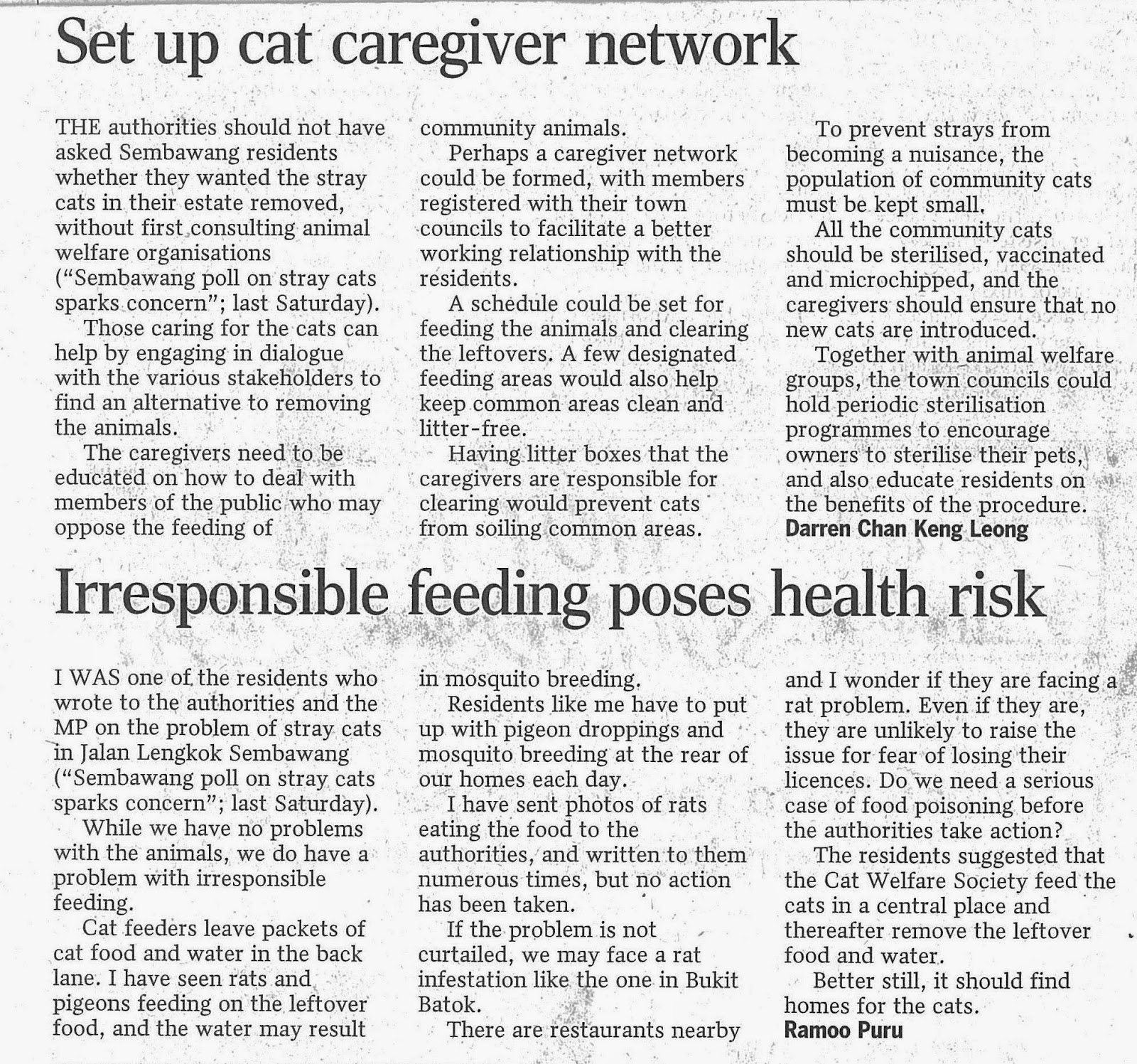
Set up cat giver network


Source: The Straits Times
Date: 6 January 2015


Source: The Straits Times
Date: 3 January 2015

Wednesday, November 26, 2014

The Purpose of Animal Welfare Organisations

Last year, Noah’s Ark Animal Sanctuary (NANAS) launched a new pilot program called the mobile Animal Birth Control (ABC) clinic to facilitate the sterilisation street cats, dogs and for owners who cannot afford the cost of sterilisation in Malaysia.

The cost of sterilisation is either at a subsidised rate or given free, depending on a case by case basis which will be assessed by Raymund Wee, founder of NANAS.

Through the continued efforts of goodwill and collaborations, Noah's Ark has also helped other animal welfare organizations such as the Society for the Prevention of Cruelty to Animals (SPCA) Johor Bahru. 


These three kittens were part of a street rescue that SPCA had conducted to reduce the number of strays through sterilisation. SPCA conducts street rescues when there is a sharp increase in the stray population or when a complaint is filed so that they can monitor the situation closely.

However, due to the high volume of rescues that SPCA JB conducts daily, the organization is also overwhelmed with the number of sick and injured animals that are in need of urgent treatment. This is where Noah's Ark comes in to lend its resources in helping SPCA JB with the temporary housing of these animals after medical treatment and sterilisation. With the ABC clinic, animals that cannot be treated at SPCA JB are brought into Noah's Ark for treatment and then returned.

By helping one another as organisations, more animals have the opportunity to find a second chance at getting a good owner and a loving home where they can live out the rest of their lives in safety and not on the streets.

At the sanctuary, these three kittens are brought in for a general health-screening and sterilisation. When the sterilisation is done, the kittens are then brought back to SPCA JB for adoption. These active collaborations between the two animal welfare organizations offer a glimpse of pooling together more resources and ways to help more animals. This will in turn give more animals the chance to lead better lives and to actively reduce the stray population through active partnerships and collaborations.

However, Raymund hopes that the many animal welfare organisations stay focus and are passionate in helping the animals whole-heartedly and not half-heartedly. He gives an analogy of an accident prone area where there is a high amount of accidents; there should be preventive measures to reduce the number of accidents by installing more lights and to address the issue thoroughly to prevent more casualties. It is necessary to sterilise all the strays and not only a certain portion.

He terms it as the “fire-engine syndrome” in animal welfare and it reflects on the attitude of animal welfare groups. He says, “When there is a siren, these groups will act, but they do not address the issue sufficiently to prevent it from happening again which is the problem.” He hopes that more proactive steps can be taken to address the stray problem at certain places which is to release, relocate or re-home them and nip the stray issue in the bud instead of giving up halfway.
 
By Darren Chan

Thursday, September 25, 2014

A determined volunteer who made a difference in an animal’s fife

Noah’s Ark Natural Animal Sanctuary (NANAS) has a team of dedicated volunteers in Singapore where they are known as an extended arm under Noah’s Ark Cares and in Malaysia as NANAS volunteers. 

Shalom Tye is one of our hardcore and hardworking volunteers has been named as a “Slave of Noah’s Ark” for his dedication in helping the street animals in Malaysia which has been referred to Noah's Ark Animal Birth Control (ABC) clinic.


Shalom did a street rescue and took time off his busy schedule to collect a young cat from a Malay lady in JB who took the cat in after a road accident. The grey and white cat whom is named Mass met with an accident in front of her warong (stall). 

As a stall owner, she could not afford to send Mass to the veterinary clinic for treatment due to the high incurred treatment costs and was referred to the Noah's Ark ABC clinic for medical help by Shalom.

The Noah's Ark ABC clinic found the cat to have slight scabies and lower body injuries which was sustained by the accident. The clinic performed an orthopedic examination and diagnostic imaging to confirm his injuries. Mass still has trouble walking due to the legs being injured which left them slightly wobbly and temporary paralysis.

Mass was given medication for his nerves which was slightly damaged and glucosamine as a supplement to boost his bone support and speed up the healing process. The kind Malay lady also donated RM$50 to show her appreciation in the help rendered to Mass. Being a street cat, Mass was sterilised at the clinic and is now recuperating in the sanctuary.

Raymund said, “For a volunteer to remain satisfied and committed to their work, they have to sense that their work means something and is recognised and appreciated.” The volunteers in Singapore and Malaysia have one cause in mind which is to help the animals that require help. The clinic also renders help through sterilisation such as spay days in Malaysia, animal rescue cases and animals that need medical help. Through the ABC clinic, Noah's Ark hopes to bring about a time when there are less homeless animals on the street and to avoid healthy animals from being euthanised. Through the volunteers, they are special individuals who have helped people and helped the animals.

by Darren Chan 

Tuesday, July 29, 2014

Executives by day, cat-women by night

Two volunteers explain why they devote their after-work hours 
to the Trap-Neuter-Return-Manage (TNRM) Programme, 
which they believe is a better way of controlling 
Singapore's stray cat population compared to culling. 

SINGAPORE: Relationship manager Sharon Tang and lawyer Thenuga Vijakumar are busy executives by day, but at night, they turn into cat-women - they trap stray cats and send them for neutering, in a bid to save them from being culled.

They are doing their part in what's known as the Trap-Neuter-Return-Manage (TNRM) Programme, which Ms Vijakumar describes as a long-term solution to controlling Singapore’s stray cat population. According to the Cat Welfare Society, there are about 60,000 stray cats in Singapore.
"If you do TNRM, you're talking about taking 10 cats, neutering 10 and the number stays at 10," said Ms Vijakumar. “Cats reproduce very quickly, so culling is a very short-term solution. If you could have neutered your two cats before they became 20 cats, then you are not wasting 18 lives for no reason."
Each session spent trapping stray cats for these volunteers can be as quick as 20 minutes for three cats, but that is a rarity, they say. More often, they end up waiting for hours just to get one cat.
The work they do is also frequently misunderstood. "I think the public needs to know what we're doing here. We're not taking cats away or throwing them somewhere else,” said Ms Tang. “We even have cases of people who pass by and just decide to release the cat, not knowing what we are really trying to achieve here."
Once the cats are trapped, they are sent to the veterinarian for neutering. After surgery, the cats' left ears are slightly tipped - to identify them as neutered. Recovery takes a couple of days, after which the cats are released back to where they were found.
"There is now more recognition that TNRM is actually the most humane way of managing the cat population," said Ms Vijakumar Thenuga. "I know that each cat neutered means one less cat fight, one less potential deployment of an AVA (Agri-Food & Veterinary Authority of Singapore) trap, one less potential cat for culling." 
Source: Channel News Asia
POSTED: 29 Jul 2014 23:43

Thursday, July 10, 2014

Islandwide plan to sterilise stray cats


Source:  The Straits Times
Date: 7 July 2014


Extend reach of sterilisation scheme for strays

I WELCOME the national effort to reduce the number of stray cats by sterilising them humanely ("Islandwide plan to sterilise stray cats"; yesterday).

Sterilisation has always been the most effective way to reduce the population of stray animals. Culling sends the wrong message to the public that these strays pose a public threat, and it is a relief to hear that the number of strays being euthanised has decreased significantly.
I urge the authorities to consider a national sterilisation scheme for dogs as well.

To keep the programme sustainable, sterilisation can be carried out in private clinics, and the Agri-Food and Veterinary Authority can work with these clinics and animal welfare groups to extend coverage to more areas, especially those where the stray populations are high.

The areas of coverage should not be confined to community areas, but include industrial areas as well. There are many strays in industrial areas, and the authorities need to step up their sterilisation programme with the help of animal welfare volunteers.

It is challenging but with combined resources from all parties, these difficulties can be overcome.

Darren Chan Keng Leong


Source:  The Straits Times - Forum Letters
Date:  8 July 2014

Tuesday, July 8, 2014

Extend reach of sterilisation scheme for strays

I WELCOME the national effort to reduce the number of stray cats by sterilising them humanely ("Islandwide plan to sterilise stray cats"; yesterday).
Sterilisation has always been the most effective way to reduce the population of stray animals. Culling sends the wrong message to the public that these strays pose a public threat, and it is a relief to hear that the number of strays being euthanised has decreased significantly.
I urge the authorities to consider a national sterilisation scheme for dogs as well.
To keep the programme sustainable, sterilisation can be carried out in private clinics, and the Agri-Food and Veterinary Authority can work with these clinics and animal welfare groups to extend coverage to more areas, especially those where the stray populations are high.
The areas of coverage should not be confined to community areas, but include industrial areas as well. There are many strays in industrial areas, and the authorities need to step up their sterilisation programme with the help of animal welfare volunteers.
It is challenging but with combined resources from all parties, these difficulties can be overcome.

Darren Chan Keng Leong

Source: The Straits Times
Date: 8 July 2014

Friday, June 7, 2013

The street is not their home


On Friday, 7 June - a kitten was rescued from a warong in Muar. (Warong is a Malay word means small eating kiosk)

A customer spotted this kitten at a corner of the shop and was told that she might have been hit by a motorcyclist, that was in the morning.

In the evening, she went back there again to check and the kitten was still in the same position, motionless.
The customer, contacted Puan Mariam and brought the kitten to Noah's Ark ABC Clinic (ABC stands for Animal Birth Control).

Immediately, she was given a drip, pain killer, antibiotic and a liquid diet.

Her left hind leg was broken and badly infected. Due to the kitten's weak condition, we cant arrange to amputate her hind leg, we need to boost her immune up first.

This beauty is a cross Persian and we have named her Putri (means Princess).
Update on Putri on 9 June 2013

Thursday, September 9, 2010

Guidance For Dog And Cat Population Management

Here are guidance for dog and cat population management in the most humane, effective and resource way possible. Although there is no ‘quick fix’ solution to the problems caused by roaming cats and dogs but at least this guidance would help with all the factors that SHOULD be considered and explains how a comprehensive and sustainable intervention can be designed.


Now stay alert and consecrate on the points.

BENEFITS OF HAVING PETS AT HOME

• Various scientific studies have confirmed that having pets can be benefit to their owners – in terms of both psychological health.

• They can reduce stress, which is known to improve the effective functioning of the immune system.

• The benefits of companion such as dog and cat to people’s psychological health has been a reason behind the introduction of dogs to visit patients in hospices, hospitals, prisons and handicapped homes.


BREAKDOWN OF THE BOND

• Domestication of the dog, usefulness of the dog to man and the protection that man has given to the dog in return, has led to the development of this strong bond.

• Today, man often violates this bond by allowing dogs to breed excessively and them abandoning them in great numbers, causing immense suffering to the animals themselves and, sometimes, a health risk to human society.

• Governments and local authorities confronted with the problems caused by these dogs have often turned to mass destruction in the hope of finding a quick solution, only to discover that the destruction had to continue, year after year, with no end in sight.

• Moreover, by reducing temporarily the population of straying dogs, the authorities had improved the chances of survival of the remainder and encouraged migration of stray dogs into “cleared areas”, thus exacerbating the spread of any existing diseases including rabies, if present.

• A practical consideration is that the dogs most likely to be caught in these “catch and kill” campaigns are those straying not far from home.

• The owners of these dogs may resent the activity of the dog catchers and if the dogs are actually killed, there will naturally be an outcry against the authorities.

• A human program to control dog populations should gain the support of the local community and Animal Welfare Groups.

• Removal and killing of dogs should never be considered as the most effective way of dealing with a problem of surplus dogs in the community; it has no effect on the root cause of the problem, which is the over-production of dogs.

• It is now being recognized that removal of surplus dogs alone cannot solve the stray problem.

• It is essential that long-term, proactive measures are taken, including registrations, micro-chipping, neutering and public education to create awareness.

WHAT IS STRAY?

• Any dog unaccompanied by its owner or keeper in a public place or not wearing a collar and identity tag, is legally-speaking a stray.

• Some dogs are normally left to wander near home without wearing a collar and at night are encouraged to forage for food, knocking down thrush bins and littering the neighbourhood.

• Dogs found wandering in a public place may be waiting for this owner or to be lost or have deliberately left home or have been abandoned by his owner.

• Puppies born to a straying bitch if they are not re-homed they could grow up truly ownerless and become feral. Such dogs will be difficult to catch and may play a role in transmission of disease but they have poor survival rate and are rarely a major problem.

• In breeding has its problem, namely demodectic mange which is often seen in street dogs. They will normally die a slow agonizing death.


STRAY DOG CONTROL

• A control program must be designed so that it differentiates between owned and un-owned dogs and deals with each category appropriately.

• It should be linked to an education program with aims to reduce the problem at source, that is, at the dog-owner’s home.

• Education by rescue reason (compliance) or education by execution (non compliance)


THE COST FACTOR

• The reason many governments avoid the introduction of a humane, proactive stray control program is the cost factor.

• However, this is seen to be false economy when he hidden costs of ineffective programs are examined.

• Traffic accidents, dog bites and dog related casualties and other health implication, catching and killing cost which are contracted out to private dog catchers.

• News about dog-related accident and death in your daily newspaper.

• The costs of a proactive program can be offset by well-enforced system of registration, micro-chipping with reduced rates for neutered dogs to encourage neutering and assistance to certain groups with less disposable income and caregivers of stray animals.


EFFECTIVE CONTROL

• Effective control needs a comprehensive proactive program which includes educating dog owners and proactive owners, controlling the reproduction of owned dogs, controlling the environment of supervised dogs, compulsory registration, identification and micro-chipping and licensing and control of breeders and sales outlets.

• Effective enforcement is vital.


EDUCATION

• NANAS Humane Education groups will undertake an education and awareness campaign on the responsibilities of pet ownership.

• Important elements are the commitment and care which should be given to them.

• To promote responsible pet ownership amongst existing owners.

• To prevent impulse purchase of pets in the future. (Education pamphlets will be distributed to pet shop).

• The legal responsibilities of owners will also be stressed in the education materials.

• Publication of a range of leaflets and brochures made widely available.

• Educational display inserted in dog magazines, pet shops and veterinary centres and during application of license.

• Campaign will be highlighted in the media and local Radio stations.

• Education program, whenever problems are noted, assisted by Our Animal Wardens/ Inspectors.


UNDERSTANDING THE DOG (Public Education)

• When the dog approaches you stand still.

• Let the dog do his/her job example, finding out your identity.

• A dog on the street or in the house is the keeper of their respective places.

• Never stare at the dog especially the eyes because they view it as a challenge therefore keep your head to your side. At the same time, be calm and composed.

• If in case there is disagreement and the dog does not seem to like you or your presence resulting in snaring, growling or barking, slowly back away either side keeping view on the dog.

• The cardinal point never to pet or approach a dog that is stranger to you.

• Do not chase or tease the dogs or pull their food to take away any of their items available with them.

• Do not try to interfere into a fight between the animals unless you are trained.

• Do NOT try to kick a dog!

• Be aware of mother with puppies.

ALWAYS be kind and gentle to the animals they will reciprocate in the same way as you feel. Remember animals will always prove to be the right judgement under any circumstance as they have natural instinct and justification. This is largely explains why animals so often immediately like or dislike a person.

Animal lovers have an orange glow in their aura which is seen and recognised by animals. Fear, on the other hand, gives a turgid brown look to the aura and this stimulates a reciprocal fear in the animal, together with anger and desire to attack.

Dogs, we often say, can “smell fear”.


DOG REGISTRATION AND IDENTIFICATION

• Are essential requirements for the successful implementation of a dog control program?

• Health controls such as the compulsory vaccination for rabies of dogs living along the boarders.

• Registration is a system for recording individual dogs with full details of their owners and drawing up registers.

• The most effective system will depend on national circumstances.

• It may be a central national register on computer with access to the central register available from points across the country, or in the case of a country like Malaysia, a regional system with a recognizable prefix to indicate the appropriate region. Each dog should carry a permanent identity mark or number (micro-chip) which is recorded on the central register.

• If it is made by microchip, then a visible indication should be given that a microchip has been inserted.

• For example, a tattoo indication such as an “M” on the side left ear.

• In addition, it should be compulsory for dogs to wear a collar and disc at all times outside the home.

• There must have the microchip number and owner’s telephone number. The disc can also be colour coded (with colour change each year) to provide a visual check on the updating of current year licensing. Duration of license need to be discussed.


DOGS LEFT IN TEMPORARILY HOME/KENNEL

• Where the dog is temporarily taken to another home location – such as during holidays. It is important that :

•  Full details of the temporary address are affixed to the collar, enabling the dog to be returned if it escapes.

•  Reports of lost dog are common during festive season due to certain activities like fire crackers.


DOG REGISTRATION AND ID

• The introduction of compulsory registration and identification must be accompanied by stringent penalties for abandonment of a companion animal.


REGISTRATION FEE INCREMENT

• A registration should be charged, with a lower fee for neutered animals to encourage neutering.

• The introduction of fee increment should well be publicized in advance so as not to trigger of abandonment when the fee for existing dog owners for a period of one or two years.

• This could help to prevent panic abandonment by existing owners.


NEUTERING

• Neutering (both spaying and castration) SHOULD be promoted by all possible means including education.

• Incentive (lower registration fee for neutered animals) and subsidized neutering programs.

• SPCA Selangor and DBKS Spay & Neuter clinic and NANAS Spay Shuttle.

• The apparent different financial priorities of Animal Welfare Groups and local veterinarians have sometimes made the introduction of such programs difficult.

• The benefits of being involved in such schemes should be discussed with the local veterinarians and authorities, while Welfare groups should appreciate the financial pressures of running a private veterinary.

• The contribution which low-cost neutering schemes can make to stray control program is DRAMATIC!!!!

• If it is done consistently with the breeding cycle of six month period to see an impact.

• Veterinarians have different views as to the optimum age that neutering operations should be performed and the best techniques applied.

• It is agreed that in situations where the over riding consideration is population control in an early age neutering has obvious benefits.

• Puppies and kittens can be done as early as 12 weeks old by an experience veterinarian.


CONTROLLING THE ENVIRONMENT OF UNSUPERVISED DOGS

• The holding capacity depends on availability of food and sheltering places.

• One way to reduce the “holding capacity” of any particular are is to restrict food sources by cleaning up the area.

• Particular attention should be pain to market place, roadside hawkers, restaurants, rubbish dumps, industrial sites and uninhabited places and area year-marked for development.


LICENSING AND CONTROL OF BREEDERS

• Indiscriminate breeding is a foremost factor in the over population of companion animals.

• It is vital to provide for the licensing and control of all commercial breeding establishments... higher registration fee for intact dogs.

• Stringent welfare requirements should be attached to the granting of a license (covering areas such as housing, care, attention, veterinary supervision, exercise, frequency of breeding each bitch and etc)

• All puppies sold at pet shop SHOULD be micro-chipped with a temporary license.


LICENSING AND CONTROL OF SALES OUTLETS

• There should also be a system to licensing and control of all sales outlets, including dealers and pet shops.

• Licensed sales outlets should only be permitted to buy puppies or dogs from licensed breeders thus enabling the enforcement officers to trace and control animals throughout the breeding and distribution network.


ENFORCEMENT

• Enforcement should be effective but humane.

• Personnel should be selected for their experience and ability to work and handle animals.

• They will, after all, be fulfilling an important educational and public relations role.

• It is important that their role is not devalued by the employment of unsuitable people.

• The local authority will need to ensure that satisfactory kennelling is provided for retaining animals, during the initial quarantine period, while they await for their owners to claim them or other humane decision.

• The choice of vehicle for the animal warden is also important.

• These must be well ventilated and compartmented.

• The capture techniques used should be humane, requiring patience and an understanding of animal behaviour.

• Animal wardens should receive full animal handling training and be adept at dealing with all types of dogs including aggressive ones.

• Animals should be comfortably housed, fed and given water throughout their period of detention.

• After expiry of this detention period, adoptable animals should be passed to Animal Welfare Groups for re-homing.

• Euthanasia should only be considered as a last resort when re-homing has not been possible.

• Euthanasia should remain, however, an important consideration in any program. The number of dogs kept in a kennel/ holding facility should not be allowed to increase above a maximum level, since this might in turn result in additional welfare problems.

• Where an isolated community has a small stray or feral dog population, which is not considered to be nuisance and the re-homing potential is limited, it may be practical of origin. They will have their left ear tipped for identification purposes.

• In this case, only ill, diseased or aggressive dogs need to euthanized.

 NEVER EVER DESTROY A HEALTHY DOG OR CAT!!!!!

For more info and enquiries please call 019-7159199 Mr Raymund Wee (President & Founder of NANAS)

Wednesday, May 14, 2008

Noah's Ark Rescue - Larkin Kittens

Dear All,


Last Saturday while at Noah's Ark, we received a call to go to a bus station in Lakin (JB) to rescue some kittens.

In all there were 13 of them rescued!


They were no more than 4 weeks old and were in terrible condition. Most were emaciated and eyes so badly infected that some could hardly open their eyes.

Uncle Raymund acted on a tip off and rescued all thirteen kitties. He brought them back to our clinic at Noah's Ark, where the kittens were cleaned, medicated and fed kitty milk formula from a syringe.

Volunteers and workers helped out. Had Uncle Raymund not saved them, these kittens would have eventually died from starvation and cat flu/viral infection.

It has been a few days since and I hear they are recovering and getting stronger by the day. I look forward to seeing them on my next visit to Noah's Ark.

Meanwhile, we will keep you posted with photo updates in the following weeks.

BTW, in the Straits Times Forum today, there's a post on
penalising members of the public who feeds stray cats and even a suggestion of sending cats to Peru as food to be eaten by a radio deejay.

We hope this group of people belongs to the minority.

Noah's Ark strongly advocates a humane way of reducing unwanted stray dogs and cats through TNR and we need the support of those compassionate and like minded people like you.

Please support our fund raising events actively!!

Paws and Licks,
JoJo